
Bead Mill & Three-Roll Mill Trial Testing | Optimizing Your Dispersion and Grinding Conditions
Bead Mill & Three-Roll Mill Trial Testing Overview
"Can this material really be dispersed well?" "I want to see the difference from other manufacturers' mills before purchasing."
Trial testing on an actual bead mill may be the answer.
AIMEX accepts trial test requests at any time, verifying the optimal bead mill conditions for your material and purpose.
Benefits of Trial Testing at AIMEX
We find the best solution for you.

Drawing on data accumulated over more than 60 years of trial testing, our engineers analyze the bead mill results and propose the machine and process best suited to your requirements.
Slurry evaluation with a wide range of instruments

Dispersion quality is difficult to judge with a single instrument; it requires a comprehensive assessment of multiple properties. In addition to particle size distribution and viscosity, we have instruments for detailed slurry evaluation.

Trial Test Flow
STEP1 Inquiry
Send us your test request by phone, fax, or through our website.
STEP2 Confirmation of Test Details
We confirm the test details based on our Test Request Form.
STEP3 Quotation
We submit a quotation for the test.
STEP4 Testing
Please consult us in advance about any concerns. During the discussion, we are also happy to advise on dispersion. We will do our best to help you achieve your goals.
STEP5 Test Results
We submit the particle size distribution results together with a test report.
*For three-roll mill tests, only a test record is provided.
Test Equipment & Evaluation
Trial Test Machines
Scroll horizontally to view.
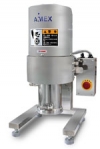
| Product | SHM | Dispersion Alphamill | Neo- Alphamill |
Easy Nano | Start Lab | New Visco Mill |
Easy Roll |
|---|---|---|---|---|---|---|---|
| Appearance |  |
 |
 |
 |
 |
 |
 |
| Use | Production | R&D / Production | R&D / Production | R&D | R&D | Production | R&D / Production |
| Features | High flow-rate operation | Excels with small beads | High-quality nanoparticles / fewer coarse particles | Small volume, easy 30mL~ Process many samples at once |
High viscosity / high concentration | High viscosity / high concentration | High-viscosity / high-concentration pastes |
| Bead size | φ0.1-2.0mm | φ0.03- 0.5mm |
φ0.03- 0.3mm |
φ0.03- 2.0mm |
φ0.3- 2.0mm |
φ0.5- 2.0mm |
- |
| Bead separation |
Centrifugal + screen | Centrifugal | Centrifugal | Separate process | Gap separator | Gap separator | - |
| Operation | Circulation / Pass |
Circulation / Pass |
Circulation / Pass |
Batch *Circulation available as option |
Circulation / Pass |
Circulation / Pass |
- |
| Motor | 2.2-75kW | 2.2-37kW | 5.5-37kW | 0.75kW | 0.75kW | 5.5-22kw | - |
Slurry Evaluation After Trial Testing
Dispersion quality cannot be judged accurately from a single measurement. It requires comprehensive observation combining multiple evaluation items.For slurries (dispersions) obtained in trial testing, in addition to standard measurements of particle size distribution and viscosity, optional measurements of particle shape, dispersion stability, coarse particle count, and specific surface area are available. Evaluating the slurry from multiple angles gives a more accurate picture.
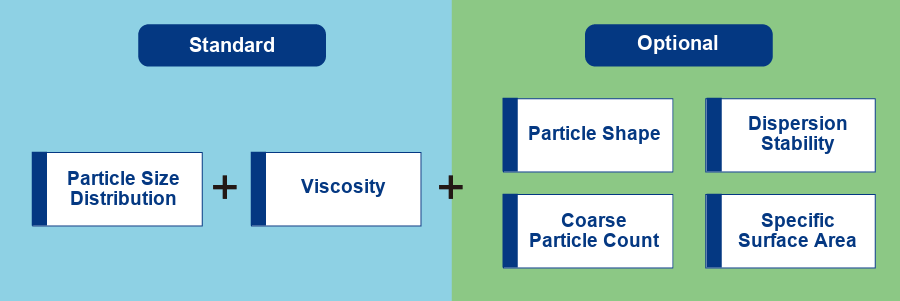
*Measurement and slurry evaluation alone, without a bead mill test, is also available. In that case, standard measurements are also charged.
Measuring Instruments
Particle Size Analyzers
Laser diffraction/scattering (LD)

| Range | 0.01~3500μm |
|---|---|
| Sample | Approx. 1–3 mL slurry |

| Range | 0.02~2800μm |
|---|---|
| Sample | Approx. 1–3 mL slurry |
Dynamic light scattering (DLS)

| Range | 0.0003~10μm |
|---|---|
| Sample | Approx. 1–3 mL slurry |

| Range | 0.0008~6.5μm |
|---|---|
| Sample | Approx. 1–3 mL slurry |
Viscometers
Brookfield-type viscometer

A rotor is immersed in the liquid
and rotated by a motor to measure flow resistance.
Easily measures a wide viscosity range.
| Range | 200~8000000mPa・s |
|---|---|
| Sample | 100 mL slurry |
Cone-plate viscometer

Uses a cone-and-plate geometry
to measure viscosity with a small amount of slurry.
Suitable for thixotropic fluids.
| Range | 0.6~176200mPa・s |
|---|---|
| Sample | 3 mL slurry |
Scanning Electron Microscope (SEM)


Suitable for checking particle shape.
| Secondary electron image | Magnification ×10–30,000 |
|---|---|
| Accelerating voltage | 5~15kV |
| Sample | Approx. 1 g powder |
Centrifugal Sedimentation Dispersion Stability Analyzer
Measures undiluted slurry from fine to coarse particles by centrifugal sedimentation to obtain a sedimentation velocity distribution.
This distribution allows comparison of dispersibility in the undiluted slurry.

Approx. range | 10 nm–100 μm
■Features
- Measures sedimentation velocity distribution of particles in dilute to concentrated slurries.
- No dilution needed—evaluate the slurry as is.
- Wide temperature range (4–60°C)
■Recommended when
- You do not want to dilute because of agglomeration
- Samples are difficult to evaluate by LD or DLS
■What to prepare
Target sample and a reference sample for comparison (slurry)
■Applications
Inks, cosmetics, ceramic materials, battery materials, etc. (solvent-based slurries also supported)
■Measurement example
TiO2 + BaCO3 slurry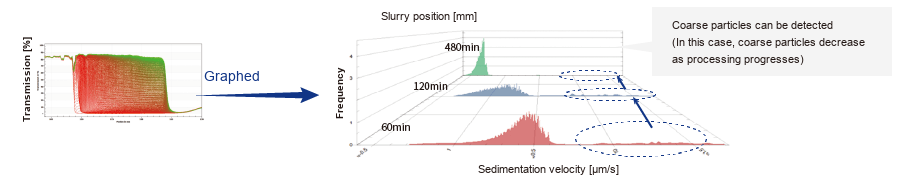
Particle Counting Size Distribution Analyzer
Counts coarse particles that cannot be measured by laser diffraction/scattering (LD) or dynamic light scattering (DLS).

Range | 0.5–400 μm
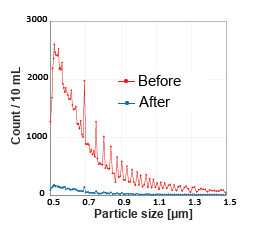
The graph shows the distribution of how many particles of 0.5 μm or larger
are present in 10 mL of slurry.
■Features
- Detecting particles one by one, this method helps observe low concentrations of coarse
(agglomerated) particles that standard analyzers find hard to detect. - Measures in both aqueous and organic solvent systems.
■Recommended when
- You want to know whether coarse or agglomerated particles are present
- You want to know the distribution on the coarse side
■What to prepare
Target sample and reference sample (slurry), dilution solvent (1–2 L per sample), cleaning solvent
■Applications
Battery materials, ceramic materials, inks, etc.
Specific Surface Area Analyzer
The slurry is dried to powder, and the adsorption isotherm is measured by the multi-point gas adsorption method to calculate specific surface area.

Range | 0.01 m²/g and up
■Features
Detects small amounts of ultrafine particles that other instruments cannot, by measuring specific surface area■What to prepare
Target sample and reference sample (0.5–1 g or more of powder)
*Slurries can also be measured after drying to powder.
■Recommended when
Slurries whose processing results cannot be judged from particle size distribution
■Applications
Test Results & Documents
Sample Test Report
Test Report
・Test details, results, discussion, summary, particle size distribution
(Comparison of bead size, concentration, and additives; scale-up results; bead mill efficiency)
Our engineers analyze the bead mill results and propose
the machine and process best suited to your requirements.
*For three-roll mill tests, only a test record is provided.
Test Location
R&D Center, Soka Factory
62 Minamigoya, Yashio-shi, Saitama 340-0831, Japan
15-minute walk from the east exit of Soka Station (Tobu Skytree Line)
Test Request Form Download (Bead Mill / Three-Roll Mill)
Before testing, we review the Test Request Form. Please download and fill in the sample PDF below and attach it to youronline inquiryso we can arrange your test smoothly.

Three-roll mill test request form / PDF (209 KB, Japanese)

Trial Testing Documents

Download the evaluation service leaflet for free (A4 portrait, 4 pages, Japanese).
Trial Test Request
Feel free to contact us about feasibility, pricing, and scheduling.