
Bead Mill That Improves Dispersion Efficiency and Quality Across a Wide Range of Peripheral Speeds|Dispersion-Alpha mill

The Dispersion-Alpha mill is a bead mill for material manufacturers who want to improve dispersion efficiency with small diameter beads while preserving the particle structure. With a wide range of peripheral speed settings, it achieves stable dispersion as intended, solving problems common with traditional machines, such as abnormal power, outflow of beads, and reduced efficiency.

φ0.03–0.5 mm
What Is the Dispersion-Alpha mill (DAM type)?
Bead mills require adjusting many conditions for dispersion, pulverization, and microparticle formation, such as peripheral speed, flow rate, and bead diameter. However, traditional machines may face the following problems.*This is only an example. Problems and results vary depending on conditions.

Setting a high peripheral speed for efficiency causes beads to become uneven and dense, applying excessive intensity.
- Destruction of particle structure
- Operation stops due to increased viscosity or abnormal power

Setting a low peripheral speed to preserve the particle structure makes it hard for beads to move, lowering processing speed.
- Reduced efficiency


The Dispersion-Alpha mill was developed to solve these problems. With a wide range of peripheral speed settings, it achieves stable dispersion as intended.
What Is Good Dispersion? Thinking About Dispersion Quality
In dispersion processing, reducing particle size often becomes the goal. However, small particle size alone does not necessarily mean “good dispersion.” In general, good dispersion meets the following criteria:- Uniform dispersion down to the target size (nanoparticles)
- No increase in viscosity or re-agglomeration caused by the destruction of particles as dispersion progresses
- A dispersion state that remains stable after processing
In actual manufacturing, it is also important to achieve this dispersion state efficiently and reproducibly. For this reason, along with dispersion quality, the ability to process efficiently under appropriate conditions is essential when evaluating a practical dispersion process.
Features of the Dispersion-Alpha mill
Stable Operation Even at High Peripheral Speeds: Dispersion Without Destroying the Particle Structure
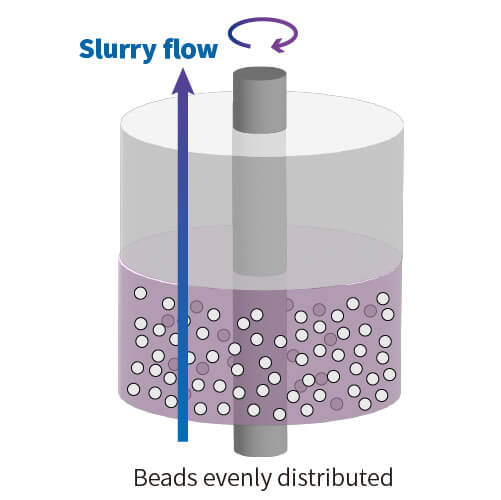
The special shape of the dispersion chamber (lower vessel) prevents beads from becoming uneven and dense.
High Efficiency Even at Low Peripheral Speeds: Nano-Dispersion and Microparticle Formation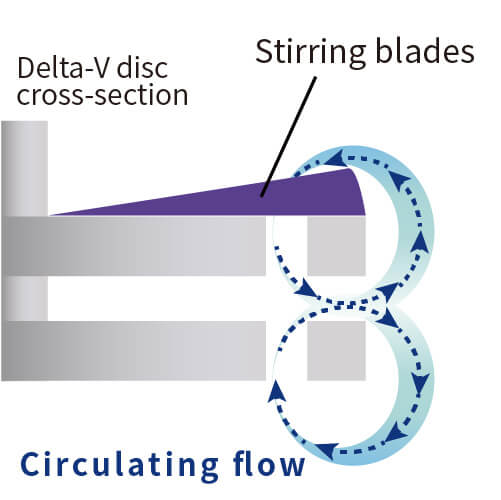
The circulating flow from the patented Delta-V disc and stirring blades moves beads efficiently even at low peripheral speeds.No Outflow of Beads Across a Wide Range of Peripheral Speeds
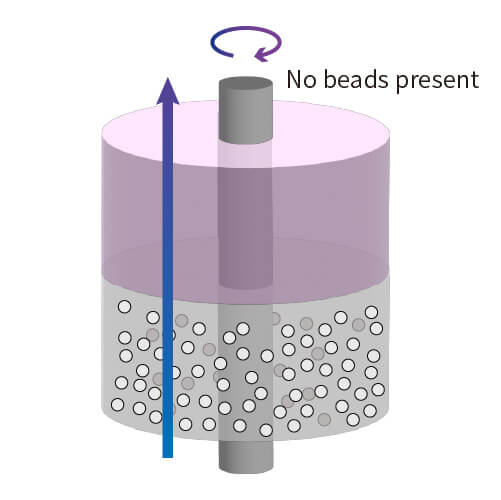
The centrifugal separation chamber (upper vessel) maintains high centrifugal separation performance, achieving high bead separation even with a single-axis structure.Our catalog includes data showing that the Dispersion-Alpha mill can disperse with “no abnormal power” and “no outflow of beads” across a wide range of peripheral speeds.
Why Destruction of the Particle Structure Can Be Prevented
When adjusting conditions, such as increasing the peripheral speed or flow rate, excessive intensity can generate micropowder. This micropowder may have various adverse effects on product quality and the process.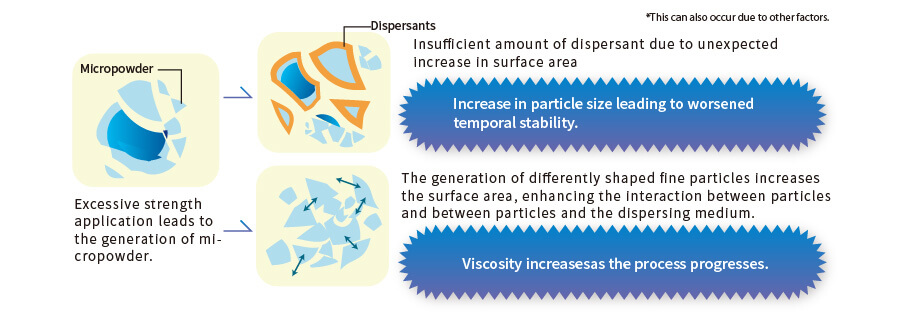
The Dispersion-Alpha mill has a structure that prevents beads from becoming uneven and dense and suppresses excessive intensity, achieving efficient dispersion without destroying the particle structure.
Processing Achievements & Applications
Ideal for materials such as titanium oxide, barium titanate, and CNF that require microparticle formation, nano-dispersion without destroying the particle structure, and prevention of re-agglomeration.Nano-Dispersion Examples
Barium Titanate|High Efficiency Even at Low Speeds! An Example of Preserving the Particle Structure
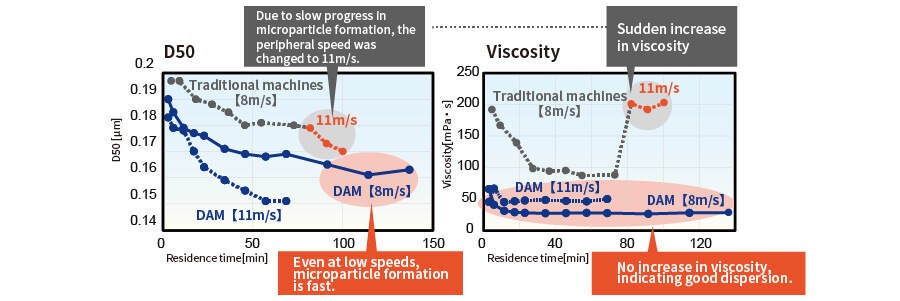
With Dispersion-Alpha mill, processing is possible without an increase in viscosity even at a peripheral speed of 11 m/s. At 8 m/s, processing is more efficient than with traditional machines.
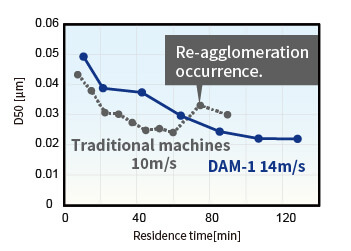
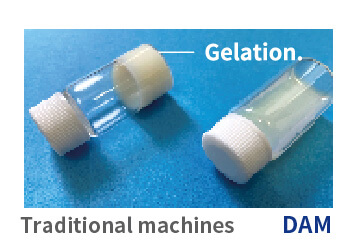
Titanium Oxide|Preventing the Generation of Fine Particles Even at High Peripheral Speeds
Pre-treatment viscosity: below 5mPa·s
In the peripheral speed range where traditional machines cause agglomeration, Dispersion-Alpha mill can disperse without agglomeration.
Calcium Carbonate|Scale-up Performance
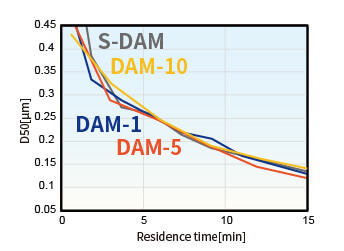
Comparing the production volume (kg/h) to reach 150nm.
Lineup & Specifications
| Model | S-DAM | DAM-1 | DAM-5 | DAM-10 |
|---|---|---|---|---|
| Bead Size | Φ0.03~0.5mm | |||
| Effective Volume (based on lower vessel) | 0.18L | 1.2L | 5.2L | 10.6L |
| Motor capacity | 2.2kW | 5.5kW | 15kW | 37kW |
*Please note that the specifications are subject to change without notice for improvement.
FAQ
Q.
What materials is the Dispersion-Alpha mill DAM type suitable for?
A.
The Dispersion-Alpha mill has a structure that allows stable operation with small diameter beads (Φ0.03mm–0.5mm), making it especially suitable for materials that require microparticle formation, uniform dispersion, and prevention of re-agglomeration. Because excessive intensity is not applied even at high peripheral speeds, it is widely used in the slurry preparation process for ceramics for electronic components, where the particle structure must be preserved during dispersion.
Japanese pageQ.
Is it possible to scale up from a small research machine to a production machine?
A.
Yes. In an example of processing calcium carbonate, when scaling up from S-DAM to DAM-1, DAM-5, and DAM-10, production volume increased at roughly the same rate as the mill capacity ratio, and microparticle formation followed the same trend. This makes it easy to achieve reproducible dispersion on production machines based on conditions obtained with the small research machine (S-DAM).
Q.
What should I be careful about when using small diameter beads?
A.
Small diameter beads (especially Φ0.1mm or less) offer high microparticle formation performance. However, depending on the machine, they can easily cause outflow of beads, increases in pressure, power, and temperature, and over-dispersion, so care is needed.
The Dispersion-Alpha mill is designed for stable operation across a wide range of peripheral speeds, even with small diameter beads, thanks to:
• High bead separation performance from the upper centrifugal separation chamber
• A lower vessel structure that prevents uneven bead distribution
• Stable bead movement from the Delta-V disc and stirring blades