Suppressing Temperature Rise During Processing
Customer's Problem
Suppressing Temperature Rise During Processing
AIMEX's Proposed Solution
Solution Through Changing Operating Conditions
It is necessary to identify why the temperature is rising.
There are several possible causes; the three most common are as follows.
The causes and countermeasures are described below.
- The powder is different (lot-to-lot variation)
- The beads are unevenly distributed
- The input energy is too high
The powder is different (lot-to-lot variation)
Sometimes heat is suddenly generated even though the same conditions previously worked without problems. This can happen when, due to lot variation, the powder contains more large particles, requiring more grinding energy and generating heat.
In this case, consider lowering the peripheral speed and increasing the bead size. Lowering the peripheral speed is effective in suppressing heat. If impact energy becomes insufficient as a result, use larger beads to compensate.
When the beads are unevenly distributed
Monitor parameters such as power; if they rise sharply, suspect uneven bead distribution. Uneven beads cause localized heat generation.
In this case, consider lowering the flow rate and the bead filling ratio. Lowering the flow rate prevents beads from concentrating at the mill outlet.
When the input energy is too high
Grinding and dispersion consume energy, much of which is converted into heat. Supplying more energy than necessary generates a lot of heat.
In this case, consider lowering the peripheral speed and using smaller beads. As long as there is enough energy to grind the powder, excessive peripheral speed only generates heat, so processing at the minimum necessary speed is preferable. If lowering the speed reduces the processing rate, smaller beads can maintain impact energy and collision frequency so that efficiency is preserved.
Solution Through Bead Mill Selection
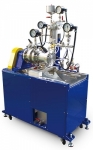
Neo-Alphamill NAM
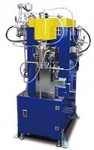
By testing on the actual mill you plan to purchase or a scaled-down model, heat calculations for the scaled-up mill can be made from the measured heat load. If heat generation exceeds the standard cooling capacity, we recommend cooling with a jacketed tank or introducing a heat exchanger.

In bead milling, results vary with operating conditions and formulation. Please feel free to contact us below to discuss whether your material can be processed.