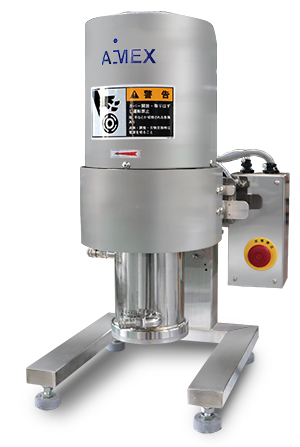
Your First Bead Mill Starts Here. EasyNano is a small batch type bead mill for research and development and prototyping. It can process small volumes from 30mL, and operation is simple: just set it up and run. Its space-saving design lets you move quickly through condition studies.
Ideal for those who want to streamline early-stage R&D, such as small-scale prototyping in the lab and condition studies (peripheral speed, bead diameter, and formulation comparison).
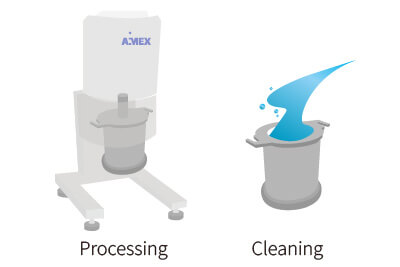
Disassembly and Assembly in 30 Seconds! More Trials in Less Time.
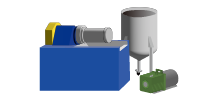
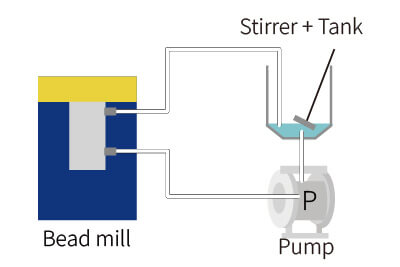
When disassembling, cleaning, and reassembling after processing, a continuous type involves ancillary equipment such as tanks, piping, and pumps in addition to the bead mill, so there are many parts and steps. EasyNano has a simple structure with few parts, making disassembly, cleaning, and assembly smooth.
▼Watch the video: disassembly and assembly completed in 30 seconds.(Japanese)
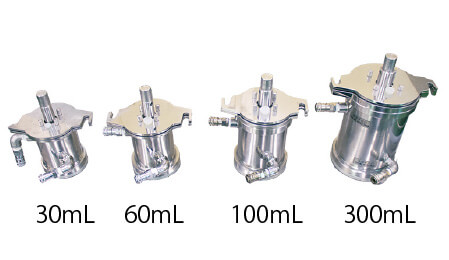
Process 30mL to 300mL by Selecting the Vessel.
Use the 30mL vessel for expensive and rare samples, or the 300mL vessel when you need a larger amount. Switching vessels lets you process each sample appropriately, and preparing multiple vessels makes processing even more efficient.
For example, prepare multiple vessels for sample changes. Processing in another vessel while cleaning saves even more time.
How to Use the Batch Type EasyNano
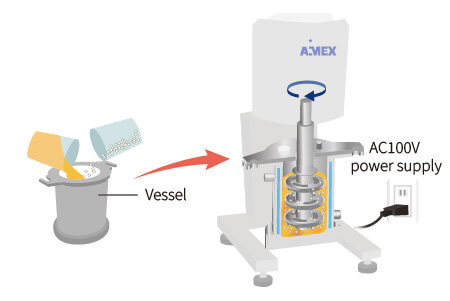
STEP 1. Simply add powder, solvent, and beads to the vessel, set it on the body, set the peripheral speed, and press the start button. *All beads of φ2.0mm or smaller can be used.
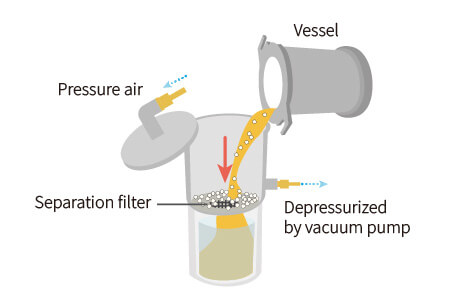
STEP 2. After processing, separate the beads using the dedicated bead separation container and collect the slurry.
Applications
EasyNano is widely used for small-volume processing and dispersion condition studies in the R&D and prototyping stages. It can grind and disperse a wide range of materials, from low to high viscosity.
Initial Study and Comparison of Dispersion Conditions
Efficiently compare, with small volumes, how dispersion behavior changes with bead diameter, rotation speed, processing time, and formulation.
Dispersion Evaluation of Small Samples and Expensive Materials
Small-volume processing from 30mL enables dispersion tests without wasting valuable samples.
Checking dispersibility with small samples
Evaluating prototype materials (small batches)
Basic Evaluation of Nano Dispersion and Microparticle Formation
Use it for basic evaluation of dispersion quality, such as checking the potential for nanosizing and tendencies toward agglomeration and re-agglomeration.
Checking particle size and dispersion state
Understanding agglomeration and re-agglomeration tendencies
Developing evaluation criteria for dispersion quality
Determining Conditions Before Scaling Up to Production Machines
As a preliminary step to production studies, narrow down conditions and organize evaluation criteria for a smoother move to the next stage.
Titanium oxide, calcium carbonate, aluminium oxide, silica, zirconium oxide, zinc oxide, iron oxide, clay (kaolin), talc, various inorganic fillers, ceramic raw materials
Electronic & functional materials
Ceramic raw materials for electronic components, conductive oxides (ITO, ATO, etc.), magnetic powders, phosphors, high-refractive-index materials, functional fine particle materials
Carbon materials
Carbon black, conductive carbon, various carbon-based fine particle materials
We propose the optimal bead diameter and operating conditions for your application and material. Feel free to consult us about tests with small samples or condition studies.
This case study shows how the dispersion state changes with bead diameter and how to carry out condition studies using EasyNano.
To Determine the Optimal Bead Diameter for Processing Inorganic Slurry
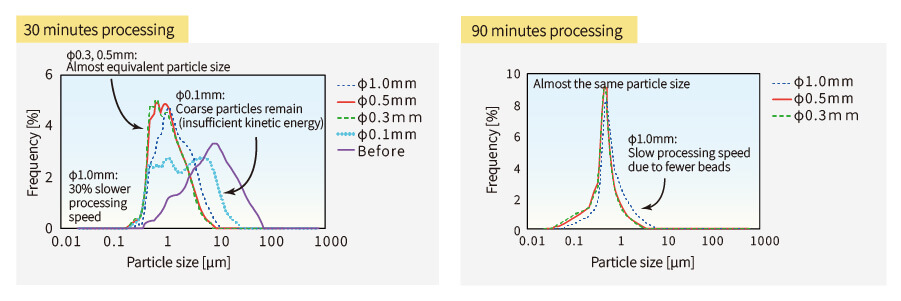
Four bead diameters (φ1.0mm / 0.5mm / 0.3mm / 0.1mm) were processed to determine the optimal bead diameter.
■Processing Results (Unit: μm)
Bead diameter
1.0mm
0.5mm
0.3mm
0.1mm
30min processing D50
1.231
0.936
0.893
1.963
30min processing Dmax
6.922
5.283
4.689
15.47
90min processing D50
0.551
0.446
0.430
-
90min processing Dmax
3.768
2.272
2.020
-
Result: φ0.3mm achieved the best particle size distribution
With four EasyNano units operating simultaneously, a condition study like this can be completed within 3 hours, from preparation to cleaning.
➡Introducing multiple units dramatically speeds up condition studies, directly improving research efficiency.
Options|Convenient Add-ons for R&D
EasyNano offers a range of options that make it easy to use in R&D and prototyping. Because it can be expanded to suit your operating style and materials, you can carry out safer and more efficient dispersion tests. The main options are as follows.
Data Utilization & Safety Enhancement Pack:Options for operation log recording and comprehensive safety measures
Explosion-proof:Explosion-proof compatibility according to customer safety standards is possible.
EasyNano is a small bead mill for R&D and prototyping with small samples. As a batch type, it makes condition studies easy, letting you evaluate dispersion and microparticle formation in the lab or on a tabletop. It is especially suited for cases such as “I want to try a small amount first” or “I want to compare formulations or bead diameters.”
Q.
Can I use it even if it’s my first bead mill? Is it easy to operate?
A.
Yes. EasyNano features simple operation that is easy to handle, even for first-time bead mill users. Just set the powder, solvent, and beads and press the start button. As a batch type with no complex piping or liquid delivery, it is less prone to operating errors and trouble, so you can use it with confidence for research.
Q.
Can I test with small volumes or limited materials?
A.
Yes. EasyNano is a small tabletop bead mill suited for small-volume processing, so you can run dispersion tests with minimal waste, even with valuable samples or expensive prototype materials. We can propose conditions based on your target particle size, viscosity, and dispersion state, so feel free to consult us even before the sample amount or study details are decided.
Q.
Can conditions determined with EasyNano be applied to production machines? (Scale-up)
A.
Yes. EasyNano is well suited for condition studies in R&D and prototyping. Organizing conditions such as bead diameter and rotation speed makes it easier to move on to condition studies for production machines. Since optimal conditions vary by material and target particle size, feel free to consult us about how to proceed with scale-up.
The following page explains our approach to scale-up.







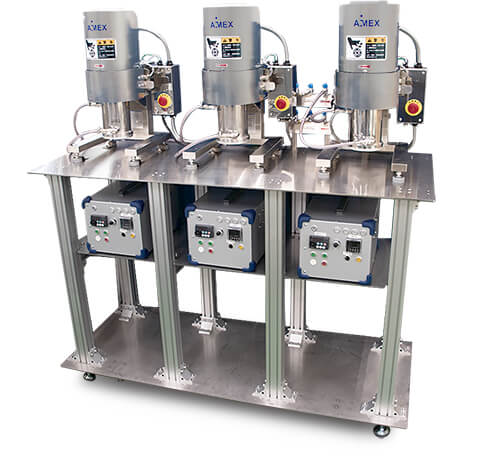
 Examples of explosion-proof specifications