The Material Does Not Reach the Target Particle Size
Customer's Problem
Particle size plateaus at a certain point and does not reach the target.
AIMEX's Proposed Solution
Solution Through Operating Conditions
When particle size has plateaued, the following causes are possible.
- The bead size is not appropriate
- The peripheral speed is not appropriate
Here is a case study in which three bead sizes were tested to find the appropriate one.
Bead Size Study
D50 values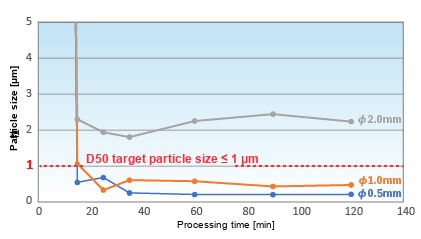
D99 values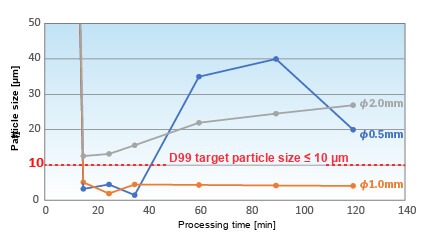
(Material) Inorganic particles
Bead mill grinding was performed with bead sizes of φ2.0 mm, φ1.0 mm, and φ0.5 mm.
| Bead size | D50 | D99 |
|---|---|---|
| φ0.5mm | 〇 Target achieved |
× Insufficient impact energy. Coarse particles are not broken down. |
| φ1.0mm | 〇 Target achieved |
〇 Target achieved |
| φ2.0mm | × Impact energy should be sufficient, but the particles do not get finer, indicating insufficient collision frequency |
× |
From these results, φ1.0 mm is judged to be the appropriate bead size for this material.
[Related page]
Bead Mill Guide: "Factors — Bead Milling Is Determined by Impact Energy and Collision Frequency"
https://www.aimex-apema.co.jp/case/2019/07/03/116 (Japanese)
Solution Through Bead Mill Selection

- Easy to use
- Free of bead size restrictions
- Able to process small volumes
The Easy Nano RMBⅡ meets all of these requirements.
The Easy Nano has a simple batch-type structure without a pump, so it is easy to use with no liquid-feed problems. With no bead size restrictions, it allows a wide range of studies. Because it can process from 30 mL, it is also ideal for grinding expensive or rare samples.
For these reasons, we recommend the Easy Nano RMBⅡ for studying bead mill processing conditions.

In bead milling, results vary with operating conditions and formulation. Please feel free to contact us below to discuss whether your material can be processed.